
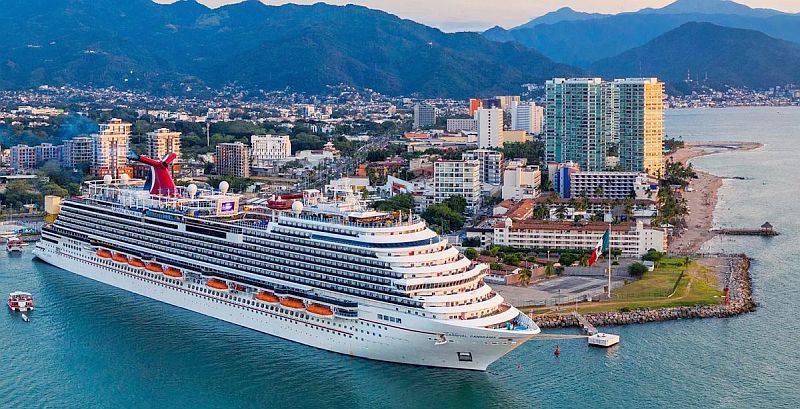
Puerto Vallarta, México – As March begins, Puerto Vallarta is preparing to welcome 14 scheduled cruise ship arrivals, reinforcing the port’s role as a key destination along the Mexican Pacific. According to the calendar released by Administración del Sistema Portuario Nacional Vallarta (Asipona), the month includes four double-arrival days, offering a meaningful boost for local businesses and tourism providers.
While the outlook remains encouraging, port officials acknowledge that schedules are subject to change. In recent days, some cruise lines have adjusted their itineraries, and industry specialist Carlos Gerard Guzmán noted that between two and four ships could potentially cancel port calls during the first half of March. As of now, no official cancellations have been posted on Asipona’s public calendar.
A tentative resumption window for regular arrivals is set between March 11 and 12, though adjustments may depend on international perceptions of safety. Authorities stress that tourism operations in the city continue without interruption. The main challenge, they explain, is not local infrastructure or services, but external perception among prospective travelers.
The month’s itinerary begins on March 10 with the arrival of the Island Princess. On March 11, a double arrival is scheduled with the Norwegian Bliss and the Royal Princess, followed by the Ruby Princess on March 12 and the Navigator of the Seas on March 13.
Later in the month, the Norwegian Bliss and the Royal Princess return together on March 18 and again on March 25. The Navigator of the Seas is set for March 24, while March 31 is expected to close the month with a double arrival of the Royal Princess and the Carnival Panorama.
Port authorities emphasize that the cruise schedule is dynamic and may be updated as conditions evolve. Even so, the tourism community remains optimistic. Cruise arrivals play a vital role in supporting transportation services, restaurants, retail shops, and tour operators across the city.
In February, 16 cruise arrivals were scheduled to dock in Puerto Vallarta, underscoring its importance within international maritime routes along the Mexican Pacific. With continued coordination between government officials and the private sector, there is strong confidence that cruise activity will stabilize and gradually expand in the weeks ahead.
As preparations continue, Puerto Vallarta stands ready to welcome visitors and reinforce its reputation as one of Mexico’s most important and reliable cruise destinations. https://banderasnews.com/
For over 25 years, Banderas News has been the pulse of Puerto Vallarta, bringing you stories that matter most to residents and visitors alike. From breaking news to exciting events and cultural features, we’ve been dedicated to keeping you informed and connected – free of charge. Your contribution helps us maintain this commitment and continue serving our community.
QUICK FACTS ABOUT PUERTO VALLARTA
LOCATION: Pacific coast of Mexico along Banderas Bay, Mexico’s largest natural bay in the northwest corner of the state of Jalisco. Puerto Vallarta is at the same latitude as Hawaii. Approximately two hours and fifteen minutes flying time from Los Angeles, California, and further south, approximately thirty minutes flying time from Cabo San Lucas and the tip of Baja California. Five hours of flying time from NYC.
TIME ZONE: Puerto Vallarta is in the Central time zone and also uses Daylight Saving time. However, they rarely change at the same time as the US and Canada, as it is a relatively new concept (approximately ten years old) in Mexico. In Nayarit, just north of the Puerto Vallarta International airport, there is a different time zone at the Ameca River, which is the border between the state of Jalisco and the state of Nayarit. However, as the entire zone is considered one destination, a few years ago, they switched to the same time zone as Puerto Vallarta, Central.
CLIMATE: Tropical humid with approximately 300 sunny days per year, average temperatures of 28 Celsius or 82 Fahrenheit. Rainy season begins at the end of June and lasts to mid-October, with average temperature high of 92F and low of 70F. The rains are usually late in the day or at night, and only a few days per week.
POPULATION: Approximately 350,000 persons, with 2 million visitors annually
CURRENCY MONEY EXCHANGE: The legal currency is the Mexican Peso, shown as a “$2” or indicated as MN. However, US and Canadian Dollars can often be accepted and can easily be exchanged at local banks or Money Exchanges. Most travelers use local Bank Machines to withdraw pesos from their bank accounts.
THE CHURCH OF OUR LADY OF GUADALUPE: This landmark church took 33 years to build from 1918 to 1955.
MARIACHI: Jalisco is the home of this Traditional Mexican music.
WATER: The water company of Puerto Vallarta has won many awards for quality. However, the aging infrastructure may affect the quality so we suggest you always drink bottled water unless you are staying in a luxury villa or resort hotel with ultra violet state of the art purification.
RESTAURANTS: There are more than 250 in Puerto Vallarta.
BEACHES: Puerto Vallarta has been named the best beach in Latin America by Travel and Leisure Magazine Readers Survey all 25 miles of it.
CUSTOMS: While the world is becoming smaller all the time and there are many American businesses here: McDonalds, Burger King, Starbucks, Costco, Office Depot, and Wal-Mart to name a few, there are still customs that may surprise you. Siesta: many businesses still close from 2:00 p.m. to 5:00 p.m. for lunch and a Siesta or nap. This is changing, but don’t be surprised if the store you wanted to see is closed. Another interesting custom is that you must request your bill in a restaurant. It is considered very rude to bring you the bill before requested as if the waiter is rushing you out. Mexicans do not rush and are a very gracious, elegant culture.
NATURAL PARKS SANCTUARIES: There are two protected National Parks /Sanctuaries in the Bay of Banderas, Los Arcos Islands in the south bay, and Las Marietas Islands at the North Bay near Punta de Mita. Las Marietta’s islands are the home of such rare species as the Blue Footed Booby, only found in the Galapagos Islands and a few other parts of South America. Banderas Bay is a famous home of humpback whales in the winter, along with dolphins and manta rays. In the summer, sea turtles, a protected species, come ashore to lay their eggs in the sand. There are many local habitats to assist the hatchling sea turtles when they emerge from the sand. The Marriott Hotel has a habitat where they are watched and protected from birds and other predators to get to the ocean.
FLORA & FAUNA: The nearby Sierra Madre Mountains are covered in lush tropical forests with wild orchids, iguanas, and wild parrots. Just north of Puerto Vallarta, before you get to Punta de Mita, is a rich agricultural zone that grows everything from Mangos to Avocados.
TRANSPORTATION: Puerto Vallarta has grown immensely in the past 20 years, but it is still a small town, and you can walk to many of the best restaurants, shopping, and nightlife if you are staying in town. Local taxi service is not expensive and very user-friendly. If you are an adventurous traveler, try the local buses. They are a great value and a cultural experience, as you might have various vendors on your bus, perhaps a traveling musician singing for tips, a tamales salesperson, or others. Transportation from the airport is very organized and user-friendly. Most rental agents will be happy to help you set up an Airport Transfer or have the name and address of your rental villa or Resort Hotel printed on a piece of paper to show the taxi driver. Costs are posted at the airport terminal.
CASA KIMBERLY: Elizabeth Taylor and Richard Burton’s love nest was built in 1963 for $5,000 USD and sold years later for $450,000.